Plan · Weather
Snæfellsnes weather, daylight and the northern lights
Met Office averages for both coasts, sunrise and sunset at Arnarstapi through the year, and a live four-day forecast. What to expect, and when the aurora is possible.
The next four days
Wind & weather at Arnarstapi, next four days
Loading forecast…
Forecast: MET Norway (yr.no), updated every 30 minutes. Wind in metres per second, daytime maximum. Before driving, check umferdin.is and safetravel.is.
Month by month
Daylight is calculated for Arnarstapi on the 15th of each month (Iceland stays on UTC all year). Climate averages are from the Icelandic Met Office: Bláfeldur on the south coast, near Arnarstapi (1998–2021), and Stykkishólmur on the north coast (1991–2020 normals).
| Month | Sunrise – sunset | Daylight | South coast | North coast | ||||
|---|---|---|---|---|---|---|---|---|
| High | Low | Rain | Wind | High | Rain | |||
| Jan | 11:10–16:18 | 5 h 08 | 3° | -2° | 133 mm | 7 m/s | 3° | 81 mm |
| Feb | 09:33–18:04 | 8 h 32 | 3° | -2° | 115 mm | 7.1 m/s | 3° | 82 mm |
| Mar | 07:53–19:34 | 11 h 41 | 3° | -2° | 140 mm | 6.9 m/s | 3° | 73 mm |
| Apr | 06:00–21:10 | 15 h 10 | 6° | 1° | 102 mm | 6.2 m/s | 6° | 45 mm |
| May | 04:13–22:51 | 18 h 38 | 9° | 3° | 98 mm | 5.8 m/s | 9° | 40 mm |
| Jun | 02:48–00:21No real night | 21 h 33 | 13° | 7° | 76 mm | 4.9 m/s | 12° | 32 mm |
| Jul | 03:37–23:40No real night | 20 h 03 | 15° | 9° | 94 mm | 4.9 m/s | 14° | 34 mm |
| Aug | 05:21–21:53 | 16 h 32 | 14° | 8° | 128 mm | 5 m/s | 13° | 51 mm |
| Sept | 06:56–20:00 | 13 h 04 | 11° | 6° | 208 mm | 6.2 m/s | 11° | 78 mm |
| Oct | 08:27–18:12 | 9 h 45 | 7° | 3° | 163 mm | 6.8 m/s | 7° | 68 mm |
| Nov | 10:09–16:27 | 6 h 18 | 5° | -0° | 155 mm | 7.2 m/s | 4° | 69 mm |
| Dec | 11:35–15:24 | 3 h 49 | 3° | -2° | 140 mm | 6.9 m/s | 3° | 85 mm |
What the numbers mean
Summer (June–August)
The warmest months average 14–15 °C at midday on the south coast and rarely much more. From mid-May to late July the sky never gets darker than twilight, so you can walk the coast at midnight. The driest months are June and July; September is the wettest on the south side, averaging over 200 mm.
Autumn (September–October)
Still 9–13 hours of daylight, darker nights for the aurora, and the first winter storms. Snowcat tours on the glacier stop after July, and the Djúpalónssandur toilets close in mid-October.
Winter (November–February)
Rarely very cold at sea level: average lows are around −2 °C, average highs about 3 °C. The problem is light and wind. With 4–6 hours of daylight a full loop of the peninsula is tight, and the two mountain passes, Fróðárheiði (361 m) between the south and north coasts and Vatnaleið (229 m) on the way to Stykkishólmur, are where snow and wind bite first. Check umferdin.is or call 1777 (06:30–22:00) before you set off. Arctic Adventures drops Ytri Tunga from its tour in December and January for lack of daylight.
Spring (March–May)
Daylight comes back fast: from 11½ hours in mid-March to 18½ in mid-May. Snowcat tours start in March, whale watching from Ólafsvík in February, and by late April the nights are already too light for the aurora.
Northern lights
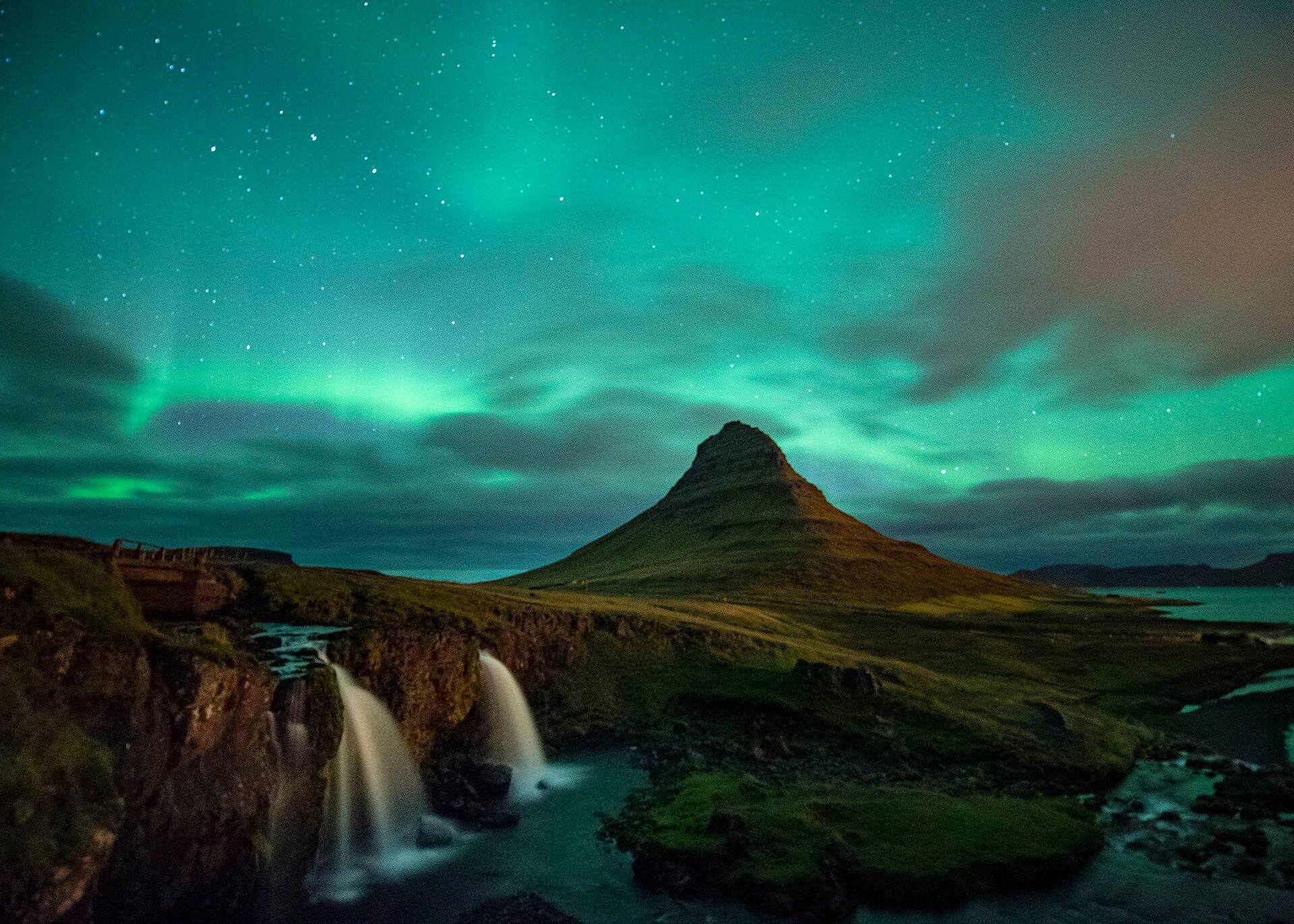
You need three things at once: real darkness, a clear sky and solar activity. Snæfellsnes has little light pollution outside the villages, and Kirkjufell and Búðakirkja are favourite foregrounds. Darkness is the hard limit. We calculated that at Arnarstapi the sun stays less than 12° below the horizon all night between about 26 April and 17 August 2026, so the sky never gets dark enough. From late August to mid-April it can happen on any clear night.
What to pack, any month
- A windproof and waterproof jacket and trousers: wind and rain, not cold, are the usual problem.
- Warm layers, hat and gloves, even in summer by the glacier.
- Shoes with grip; microspikes from October to April for icy paths.
- An eye mask in June and July.
Questions people ask
What is the best month to visit Snæfellsnes?
For long days and open roads, June to August: over 16 hours of daylight and average highs of 14–15 °C on the south coast. For northern lights with daylight left for sightseeing, September–October or February–March.
Can you see the northern lights on Snæfellsnes?
Yes, away from the villages the sky is very dark. But not in early summer: at Arnarstapi the sun never gets more than 12° below the horizon between about 26 April and 17 August, so the sky never gets dark enough. You need darkness, clear skies and solar activity together; the Icelandic Met Office publishes a cloud and aurora forecast.
How many hours of daylight are there in winter?
On 15 December the sun rises at Arnarstapi at 11:35 and sets at 15:24: under four hours. On 15 January it is just over five hours, and by 15 February eight and a half.
Is it always windy?
Often. The average wind speed on the south coast is about 7 m/s from November to February and about 5 m/s in June and July. Gusts are what matter on the road: hold car doors with both hands.
Does it rain more on the south or north side?
The south. Bláfeldur, on the south coast near Arnarstapi, averages about 1,550 mm a year; Stykkishólmur on the north coast about 740 mm.